
A JOURNEY by Elena Vasileva
Stories We Become
REHEARSING REGENERATIVE FUTURES

What if the stories we live by could shape the futures we want to see?
Over the course of 12 weeks, we gather in a co-creative rehearsal space where imagination meets action. Through the regenerative cycle of Rooting → Composting → Planting → Weaving → Flourishing → Harvesting, you’ll experience a facilitated three-month practice for transforming how you understand, question and work with stories — personally, culturally and professionally.
Next cohort begins on 15. of November
Why This Journey Exists

We live within stories that shape what we value, how we relate to one another, how our societies are organised, and what we believe is possible. Many of these stories have become so familiar that we rarely stop to question them.
In a world shaped by acceleration, fragmentation and overlapping crises, responding differently requires more than finding better solutions within the systems we already know. It asks us to examine the assumptions beneath them, recognise the connections between stories, culture and the living systems we are part of, and expand our capacity to imagine other ways of being.
This begins with how we learn to see, listen and relate. With making space for uncertainty, encountering perspectives beyond our own and allowing imagination to take us somewhere our familiar ways of knowing cannot. It means moving between reflection and action, exploring how the stories we tell ourselves become the practices we embody, the relationships we nurture and the worlds we help bring into being.
Stories We Become is a space to explore these possibilities together.
“Change has to happen in the story we tell.”
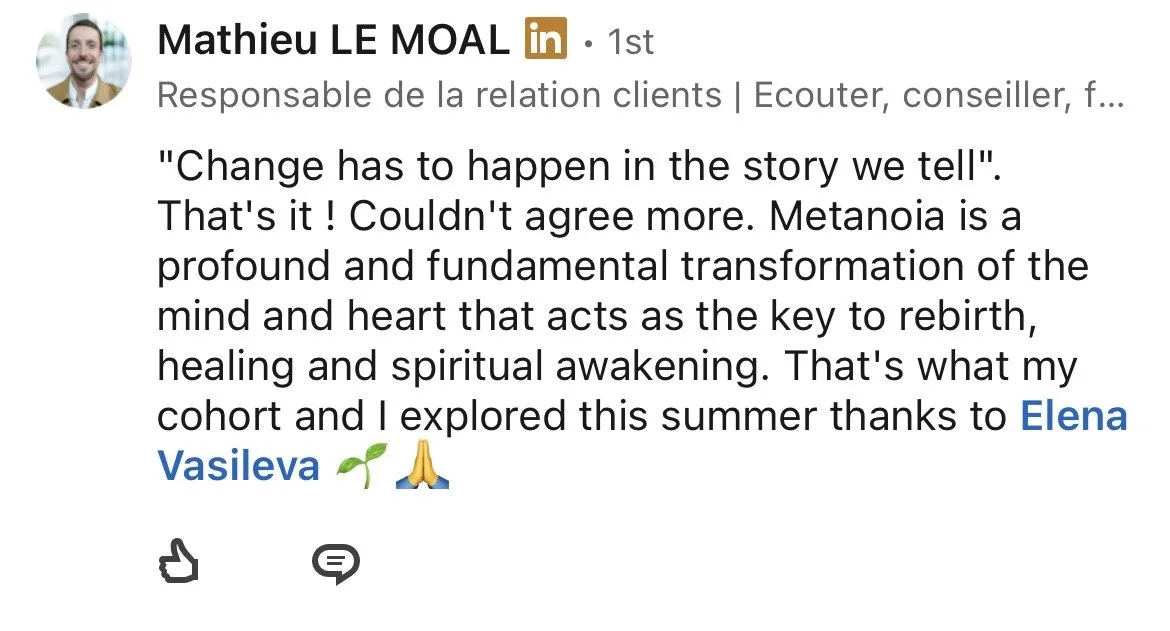
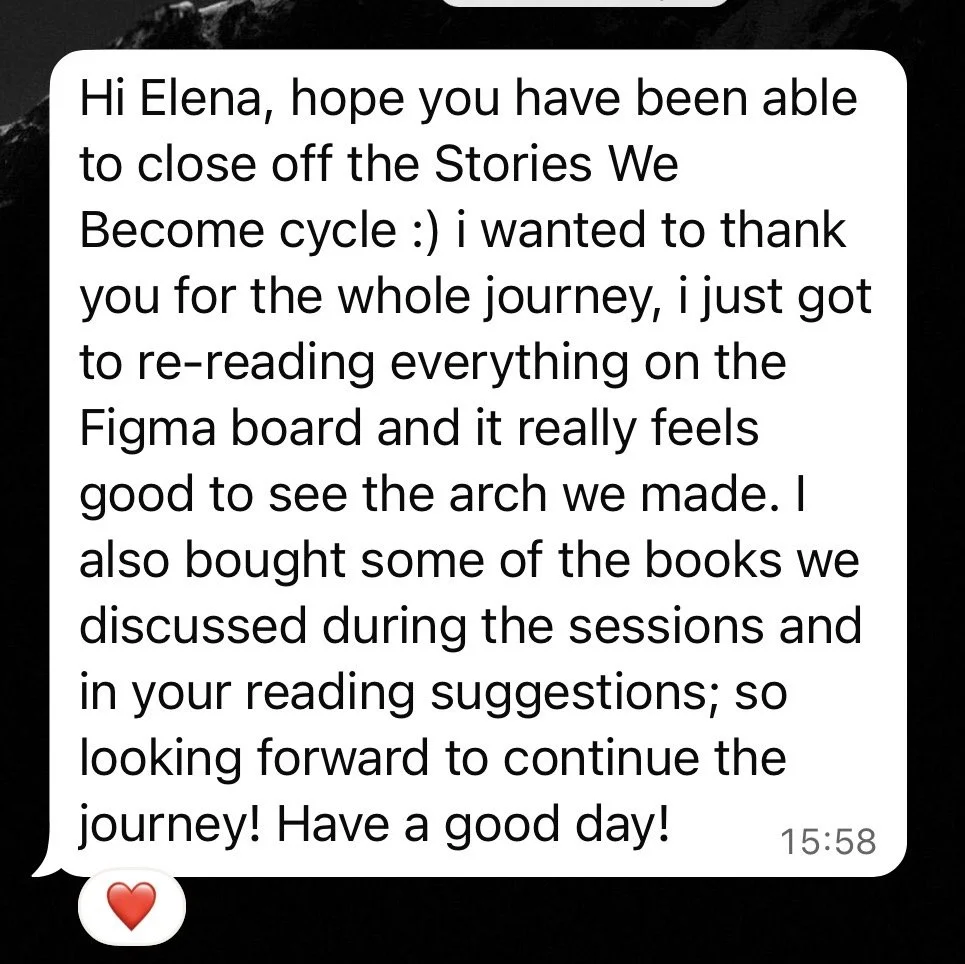
That’s what stayed with me most. Through Stories We Become, Elena created a space for a profound transformation of mind and heart—a kind of metanoia that invites rebirth, healing and awakening. Together with my cohort, I explored how changing the stories we carry can open the possibility for changing how we see ourselves, our lives and the future we are becoming part of.
Mathieu LE MOAL
Multi-disciplinary thinker and writer
This Journey Is For You If:
You want to understand the stories shaping the worlds we inhabit — how they influence what we value, whose knowledge we trust, how we organise our lives, and what futures we consider possible. You’re curious about how inherited narratives can be questioned, reimagined and transformed.
You are drawn to decolonial thought and practice, and want to explore how dominant worldviews are reproduced through culture, institutions and everyday relationships. You are interested in moving beyond critique to practise different ways of knowing, relating and being in the world.
You want to strengthen your ability to think systemically: to recognise patterns, trace connections and understand how individual stories, cultural narratives and wider structures influence one another. You’re interested in working with complexity rather than reducing it to simple problems and solutions.
You sense that imagination is essential to meaningful change, yet often gets sidelined in professional, institutional and political spaces. You want to develop the confidence and creative practices to use imagination as a way of questioning assumptions, exploring alternatives and engaging with uncertainty.
You work as a designer, facilitator, researcher, educator, coach or community practitioner, and want to bring regenerative storytelling, futures thinking and collective imagination into your existing practice. You’re looking for methods that help you create space for different perspectives, make connections visible and support people in exploring new possibilities together.
You are developing a project, initiative or practice rooted in care, justice or ecological and social transformation, and want to explore the narratives that hold it together. You want to connect your intentions to a deeper understanding of the cultural and systemic context you are working within, and develop ways of bringing your ideas into practice.
You love literature, poetry, speculative fiction or creative expression, and want to move from engaging with stories to working with them as a practice — exploring how fiction, metaphor and storytelling can shift perception, challenge inherited assumptions and make unfamiliar futures more tangible.
You are looking for a space where you can think beyond the familiar alongside others — exchanging perspectives across disciplines, experimenting with ideas and developing relationships with people who share your curiosity about more regenerative futures.
Taylor B. Anderson, MS
Systems and futures-oriented strategist
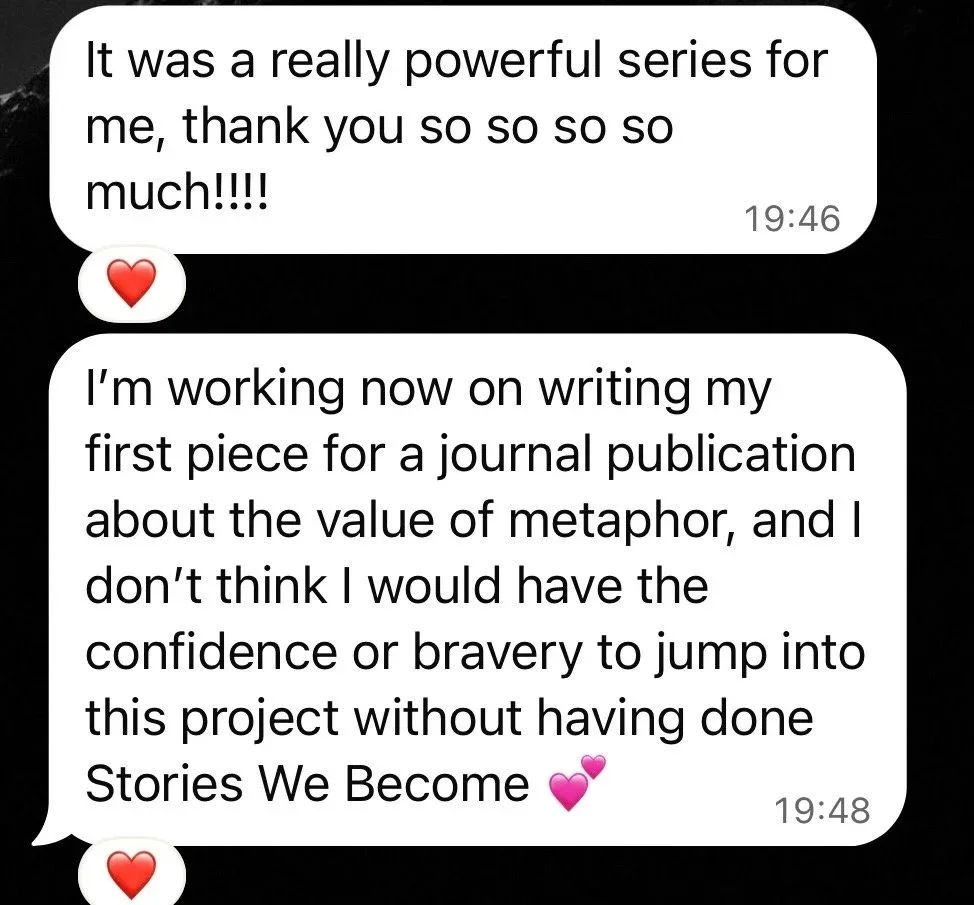
Testimonials
✦
What The Community Is Saying
✦
3.000+ Care-Full Futurists
✦
Testimonials ✦ What The Community Is Saying ✦ 3.000+ Care-Full Futurists ✦
What You Will Be Practicing & Embodying:

A framework for regenerative storytelling
Develop a practical framework for understanding how stories move between personal experience, collective culture and the systems we inhabit. Learn to trace the connections between narratives, power, relationships and the more-than-human world, and use these insights to shape stories and practices that nurture more reciprocal, life-affirming ways of living.

Practices for recognising and transforming inherited narratives
Explore the assumptions, worldviews and cultural narratives that shape how we see ourselves, others and the future. Develop ways to question dominant perspectives, recognise whose knowledge is centred or excluded, and make space for different ways of knowing, relating and being in the world.

Systems thinking, futures literacy & decolonial imagination
Strengthen your ability to see patterns, relationships and feedback loops across seemingly disconnected parts of a system. Explore how stories influence what we perceive, what we consider possible and how we respond to the situations we find ourselves in. Use futures thinking and speculative storytelling to question dominant ideas of progress and rehearse possibilities beyond the systems we have inherited.

Tools for collective imagination and co-creation
Build a repertoire of participatory exercises you can bring into your workshops, research, facilitation, design or community work. Learn to work with different perspectives, surface the assumptions beneath competing worldviews, and create conditions in which people can imagine and explore possibilities together, without reducing complexity to a single shared narrative.

A project that brings your learning into practice
Develop a personal or professional project that connects the course’s ideas to the work you want to do in the world. This might take the form of a workshop, a creative practice, a storytelling experiment, a community initiative or a new direction for an existing project. The emphasis is on translating insight into practice: testing ideas, reflecting on what emerges and exploring how different ways of seeing can lead to different ways of acting.

An embodied practice of regenerative storytelling
Move beyond understanding storytelling as a concept or technique. Through reflective writing, creative experimentation, shared inquiry and collective practice, explore how stories live in your habits, relationships, decisions and ways of working. Develop a more attentive, relational approach to your practice — one that can hold complexity, remain open to uncertainty and respond to the living contexts of which you are a part.
The Journey: A Regenerative Story Cycle
The course follows an ecological rhythm inspired by how living systems grow and transform. Across six weeks, we move through a cycle of reflection, imagination, and integration—exploring how stories can evolve from inherited narratives into living practices.

Week 1-2 — Rooting
We begin by exploring the stories we inherit.
Through reflective exercises and dialogue, we map the cultural, personal, and systemic narratives that shape how we see the world and our place within it.

Week 3-4 — Composting
Not every story needs to be carried forward.
This week focuses on recognizing and releasing narratives that no longer serve us, transforming them into fertile ground for new possibilities.

Week 5-6 — Planting
With space created, we begin planting new seeds of imagination.
Through speculative storytelling, poetry and futures-thinking exercises, we explore what regenerative ways of living, relating, and organizing could look like.

Week 7-8 — Weaving
Stories do not exist in isolation—they connect people, systems and cultures.
In this session we weave emerging ideas into relational narratives that consider communities, governance, ecological belonging and shared futures.

Week 9-10 — Flourishing
Here we explore how stories come alive in practice.
Through rituals, collaborative exercises and facilitation tools, we experiment with ways stories can strengthen belonging and collective momentum.

Week 11-12 — Harvesting
We conclude by integrating what has emerged.
Participants translate their insights into tangible next steps—whether a creative project, community initiative, facilitation format or new direction in their work.
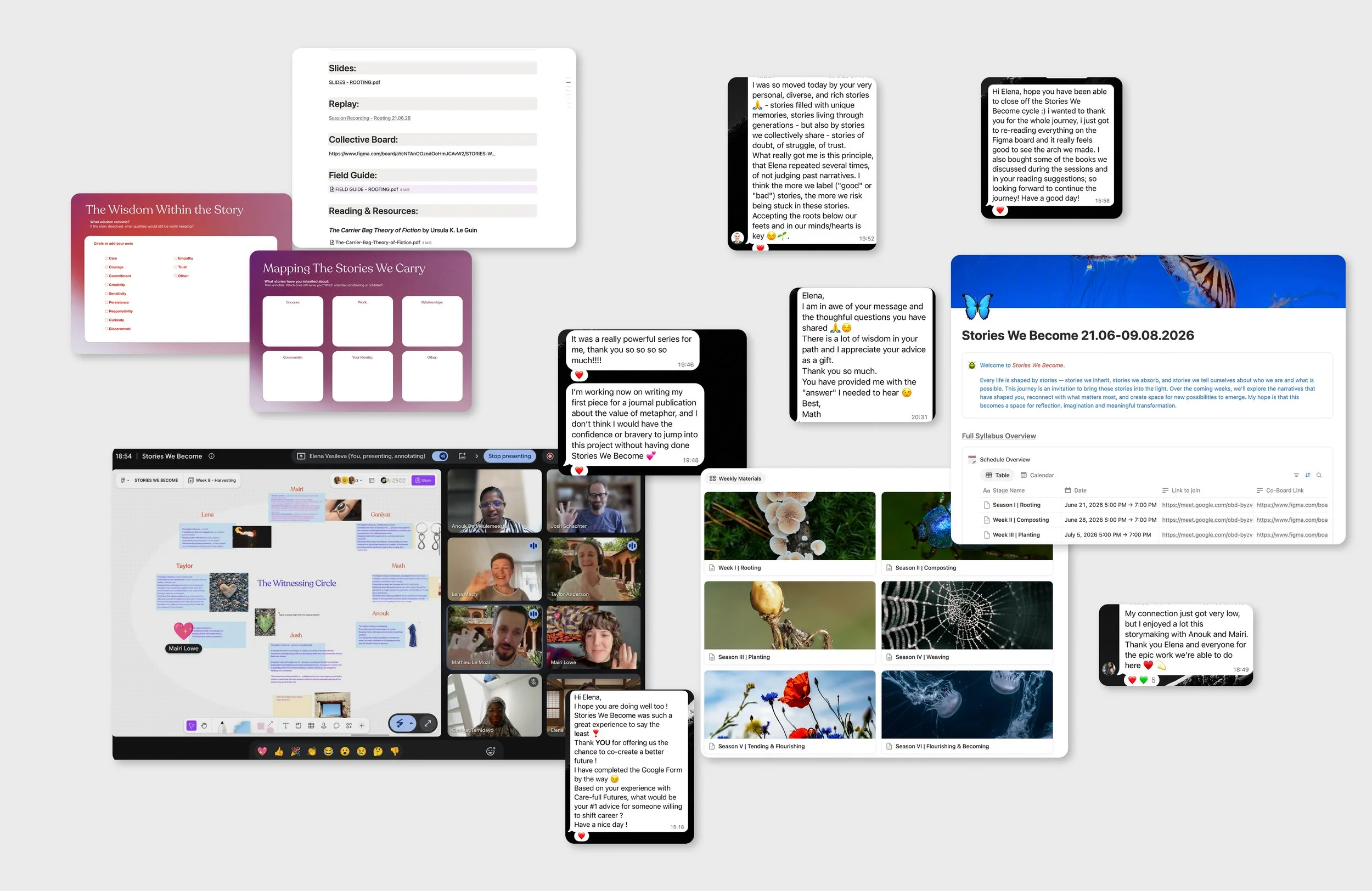
A Peek into Stories We Become World
Live Weekly Sessions
We meet for 2-hour sessions every Sunday combining conceptual input, guided exercises, and collective discussion.
What the Experience Looks Like
Lecture + Co-Creation Format
Every session begins with a short lecture introducing the weekly theme and frameworks, followed by interactive storytelling exercises, reflection prompts, and collaborative exploration.
60+ Pages Field Guide Course Companion
Participants receive a 60+ pages digital field guide and workspace where you can track reflections, exercises, and insights throughout the course.
Custom-Designed Collaborative Boards
We use shared co-creation boards for mapping ideas, building stories together, and visualizing connections between different perspectives.
Session Recordings
All sessions are recorded so you can revisit the material or catch up if you miss a session.
WhatsApp Community
A dedicated group space allows participants to share insights, ask questions, and stay connected between sessions.
Who This Course Is Designed For
Creatives & Writers
You are interested in storytelling as more than a creative output — you want to explore how stories shape culture, possibility, and collective imagination.
Facilitators & Coaches
You hold spaces for others and are looking for new frameworks, exercises, and perspectives to bring imagination and futures-thinking into your work.
Social Impact Entrepreneurs
You are building initiatives that aim to create positive change and want to ground your work in narratives that inspire participation, belonging, and long-term vision.
Designers & Strategists
You are curious about how narratives influence systems, organizations, and decision-making, and how storytelling can become a tool for systemic thinking.
Community Leaders
You work with groups, organizations, or local communities and want to explore how shared stories and rituals can strengthen collective vision and collaboration.
Students & Emerging Thinkers
You are exploring new directions in your field and want to stay connected to conversations around imagination, culture, and the future.
Practical Details
Start Date
The course begins on Sunday, 15th November.
Session Length
Each session lasts between 1.5-2 hours, combining short lectures, guided reflection, and co-creation exercises.
Schedule
Live sessions take place once a week from 15:00-17:00 CET or 09:00-11:00 EDT. Please check out the Course Syllabus for detailed schedule.
Session Recordings
Session Recordings will be available for replay and can be revisited for up to 3 months after completion.
Duration
12 weeks
Investment
1 × 650 EUR
or
2 × 325 EUR
Your Facilitator

Elena is a design researcher, storyteller, and facilitator working at the intersection of systems thinking, cultural narratives, and futures imagination.
Her work explores how stories shape the systems we live within—and how consciously working with narrative can open space for more regenerative ways of organizing our lives, communities, and institutions.
With a background in design thinking and spatial planning, Elena brings together methods from design, futures studies, and storytelling to create spaces where people can explore complex questions, expand imagination, and co-create new possibilities. She regularly facilitates workshops and learning experiences that invite participants to reflect on inherited narratives and experiment with alternative futures.
She is also the author of Care-Full Futures, a publication exploring systemic design, cultural narratives, and the role of imagination in shaping more life-centered futures.
Through her work, Elena focuses on one guiding question:
What new stories do we need in order to imagine and practice more regenerative futures?
Got a question about the course? Please refer to the FAQs below or
Schedule a FREE 20-minute call with Elena
Frequently Asked Questions
-
Stories We Become asks for a real commitment of time and attention. You don't need to be perfectly consistent, but the experience becomes much richer when you can participate in the live sessions and give yourself some space between them.
If you're currently in a period where you can't make that commitment, it may be better to join a later cohort.
-
The live sessions are an important part of the experience because much of the learning happens through conversation, collective reflection and co-creation. We strongly encourage you to aim for at least 70% attendance.
-
Across the journey, you'll work with personal stories, cultural narratives, future scenarios, writing, visual prompts, conversation, mapping, reflection and narrative design exercises.
Some weeks involve deeper individual reflection. Others centre on dialogue, small-group work, collective sensemaking or designing and testing alternative narratives.
-
Stories We Become isn't primarily about acquiring more knowledge. It's about creating the conditions to notice, connect, question and apply what you already know.
-
Yes. Stories We Become can be particularly meaningful if you're in a period of professional transition and are questioning what you want your work to become.
The experience gives you space to explore the stories, expectations and definitions of success that have shaped your relationship with work — while imagining different possibilities for how you might contribute, create and live.
Rather than helping you choose a specific career path, the programme helps you develop a deeper awareness of what is changing, what you are moving away from, what is emerging, and what kind of future you want to rehearse.
You don't need to arrive knowing your next step. You can come with a question, a sense that something is changing, or simply the feeling that the story you've been living by no longer fits.
-
Social and systemic change is shaped not only by the structures we work within, but also by the stories through which we understand those structures — what we believe is possible, what we consider valuable, and what kinds of futures we can imagine.
Stories We Become gives you space to examine the narratives underlying your work: the assumptions, metaphors, cultural beliefs and ideas about progress, success, human behaviour or the future that may be influencing how you frame a problem and what solutions you can see.
You'll learn to move between the personal, cultural and systemic dimensions of a story, then use narrative design to imagine and begin rehearsing alternatives.
You might apply this to a real project, organisation or challenge you're working on — questioning an existing narrative, identifying what it makes possible or impossible, and exploring what could change if the underlying story changed.
The aim isn't to give you a formula for systemic change. It's to develop your capacity to see more of the system, question the stories organising it, and participate more consciously in shaping what comes next.
-
Both. Stories We Become explores the relationship between the stories we carry personally and the narratives shaping our organisations, cultures and wider systems.
We move between Me → Us → World, asking how stories shape what we see, value and make possible — and how changing our relationship to those stories can open up new ways of seeing, designing and acting.
-
Not exactly. While storytelling is part of the practice, Stories We Become is less concerned with how to communicate a story and more concerned with understanding which stories are shaping what we believe is possible in the first place.
We explore stories as cultural and systemic forces: they influence what we value, how we behave, what we design, which futures we can imagine and which ones remain difficult to see. Narrative design then becomes a way of consciously shaping alternatives — not simply communicating them more persuasively.
-
You don't need to arrive here wanting to reinvent yourself.
Stories We Become is less about becoming someone new and more about becoming more conscious of the stories you are already living inside — and developing the agency to decide which ones still deserve your participation.
Voices & Inspirations
Throughout the course, we will draw inspiration from voices who have expanded how we think about narrative, relationship, and the future.


Ursula K. Le Guin
Le Guin’s stories invite us to imagine alternative societies and ways of living together. Her work shows how speculative storytelling can question dominant systems and open space for new cultural narratives.
Octavia Butler
Butler’s writing explores how humans adapt, survive, and transform within changing worlds. Her work reminds us that imagination can be both visionary and deeply grounded in social realities.
Mary Oliver
Through her poetry, Oliver reconnects us with attention, humility, and ecological belonging. Her words remind us that imagination is rooted in how we relate to the living world.
adrienne maree brown
Through works such as Emergent Strategy, brown explores how imagination, relationships, and small-scale practices can shape larger systems of change.
Futures Literacy (UNESCO)
The course is also informed by research in futures literacy, a field that explores how developing our capacity to imagine multiple futures helps individuals and communities navigate uncertainty and shape more intentional pathways forward.
Testimonials
✦
What The Community Is Saying
✦
3.000+ Care-Full Futurists
✦
Testimonials ✦ What The Community Is Saying ✦ 3.000+ Care-Full Futurists ✦


